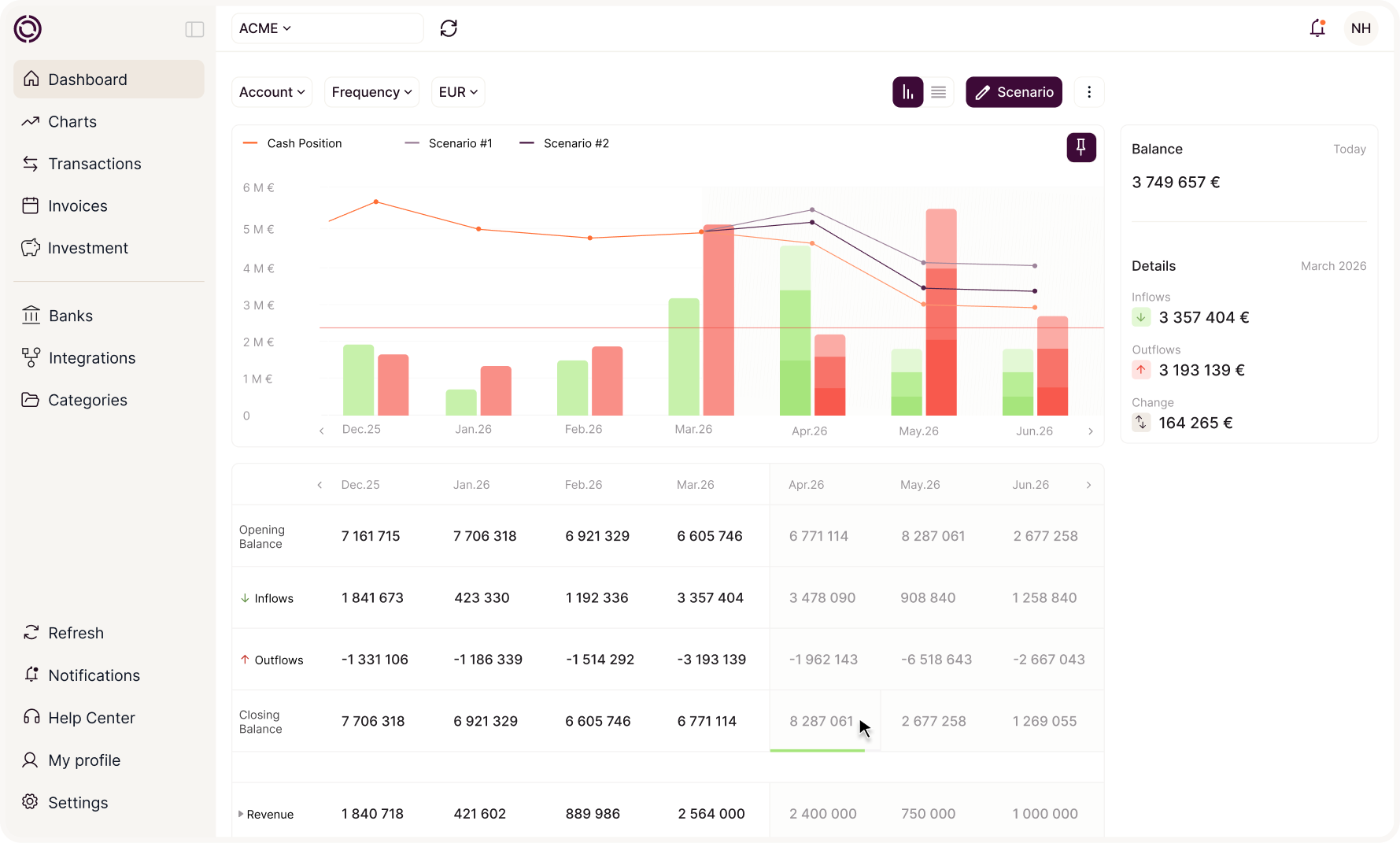
How to tackle cash flow challenges at a consulting firm?
Consulting firms face specific challenges when it comes to cash management. In this article, we start with the problems consulting firms encounter, then look at the best solutions for optimizing cash management.

Consulting firms: the essentials on cash management
Cash management is a central issue for consulting firms, whose business model relies on labor-intensive intellectual services and revenue flows that are inherently irregular. The pressure comes from a structural imbalance between immediate payroll costs, project cycles, and delayed cash receipts:
Okimia helps consulting firms manage their cash flow with precision, connecting the sales pipeline, ongoing projects, and financial projections.












The specific cash flow challenges consulting firms face
Why is cash management particularly difficult for consulting firms? We've identified 3 major challenges.

The critical gap between invoicing and payment
In consulting, the economic reality is defined by a significant structural gap between delivering a project and actually getting paid for it.
Firms have to cover the full cost of delivery — mainly highly skilled human resources — before receiving any payment at all.
This creates constant pressure on cash flow, since consultants are paid monthly while clients may have extended payment terms, sometimes exceeding 90 days.

The inherent instability of revenue
The economics of consulting firms rest on a fundamentally volatile, unpredictable revenue model.
Every engagement is a unique project, with variable duration and financial scope, generating highly irregular cash flows.
A consultant can swing between periods of intense activity and gaps between assignments with no income at all, creating constant financial pressure. This instability makes forecasting and managing financial resources particularly difficult.

The weight of intangible investment
Consulting firms need to constantly invest in developing their people — training, certifications, skill-building — without necessarily any guarantee of an immediate return on that investment.
These intangible investments, essential to staying competitive, represent a significant cost that directly affects cash flow.
The ability to fund this development without destabilizing the firm's financial balance becomes a major strategic issue, particularly for mid-sized firms.
Best practices for cash management at a consulting firm
A few days is all it takes to automate your cash management
01.
02.
03.
Master precise tracking of projects and their profitability
Financial management at a consulting firm relies largely on the ability to precisely track the profitability of every engagement. This requires thorough tracking of time spent, associated costs, and revenue generated by each project. Consultants need to systematically document their work, detailing billable hours, deliverables produced, and results achieved for the client. This tracking allows for a detailed understanding of each engagement's economic performance, helps identify the most profitable projects, and allows pricing strategies to be adjusted accordingly. Particular attention should be paid to distinguishing between billed hours, unbilled productive hours, and time spent on business development or training.
Anticipate and manage gaps between consultant assignments
The specific challenge in consulting lies in fluctuating workloads and potential gaps between assignments. Proactively managing these gaps is crucial to maintaining the firm's economic performance. This means developing a strategy of consultant versatility, training them across different areas and preparing them to work on a variety of engagements. Building a broad skill set helps reduce idle periods and maintain an optimal billing rate. At the same time, it's essential to build financial reserves to absorb these slow periods and actively monitor the market to spot new engagement opportunities.
Professionalize the management of client financial flows
A consulting firm's financial performance depends heavily on its ability to effectively manage financial relationships with clients. This means taking a professional approach to contracting, with clearly defined payment terms, precise project milestones, and transparent invoicing terms. It's recommended to set up proactive follow-up processes, with automatic reminders before payment is due and clear communication in the event of late payment. Diversifying the client portfolio also helps reduce financial risk by avoiding excessive dependence on a small number of clients. Particular attention should be paid to qualifying prospects and assessing their financial health before taking on a new engagement.

Ready to optimize your cash flow?
Discover how Okimia can transform your financial management starting today.
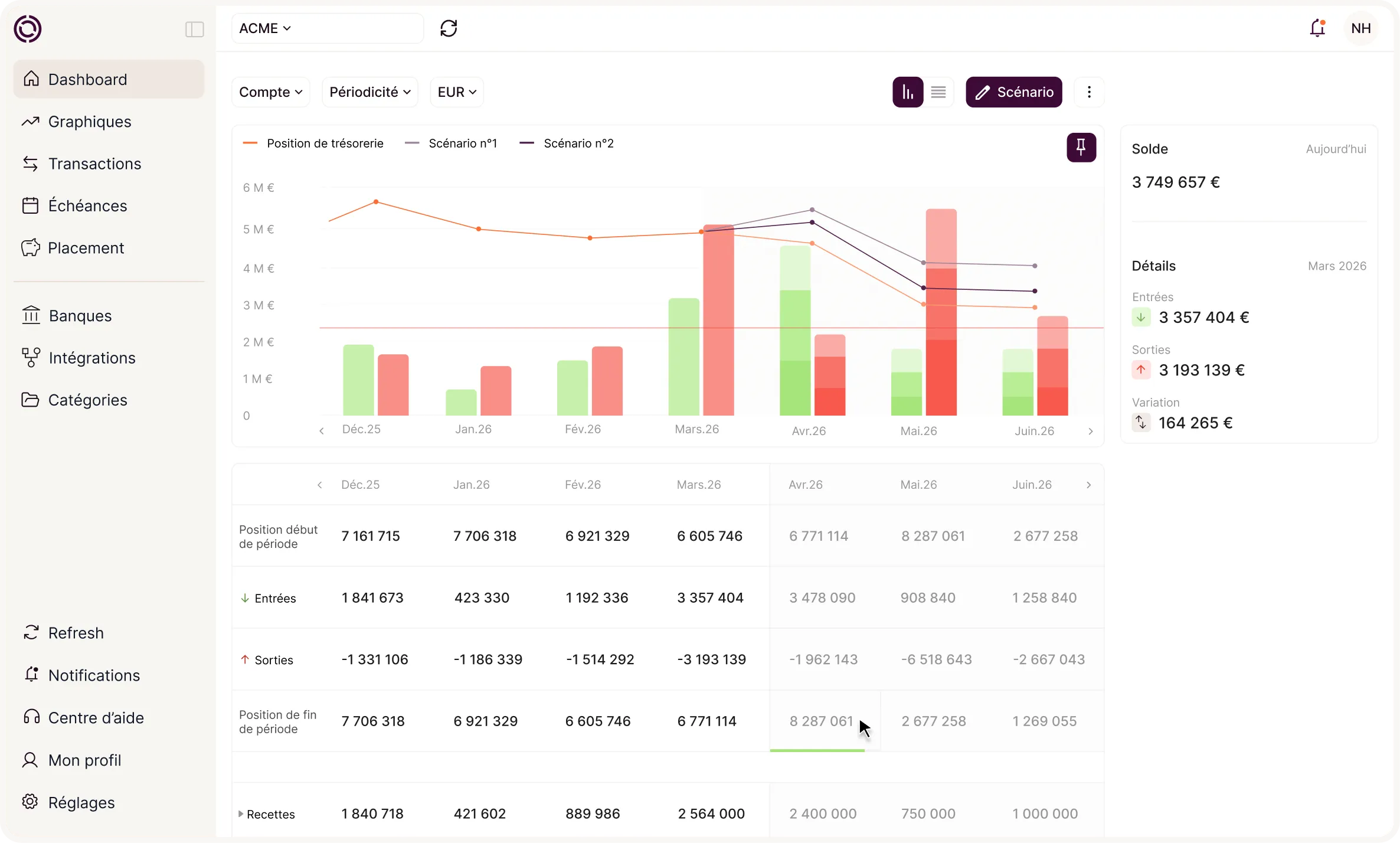
Why use Okimia for a consulting firm?
The solution for optimizing your cash management: use software designed for the job, like Okimia. We already count many consulting firms among our clients, so we understand their challenges inside and out. We've also carried out numerous custom developments for them to ensure perfect client satisfaction in this segment.
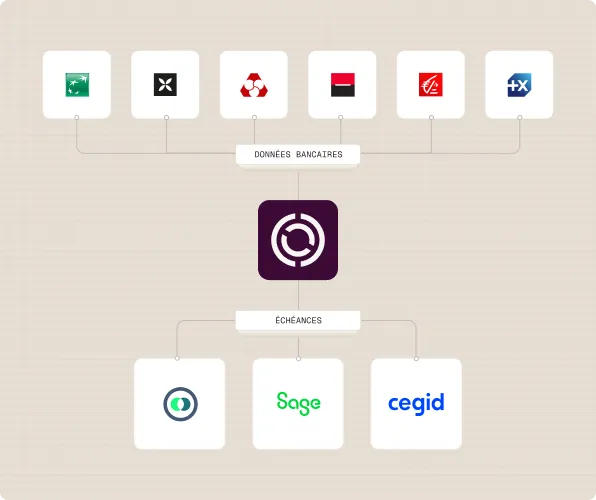
Automatic bank synchronization
Track your receipts, categorize your consulting revenue, and anticipate your financial flows effortlessly
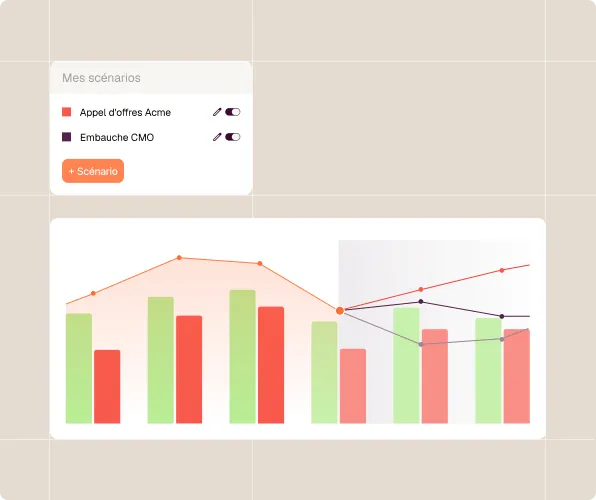
Tailored cash flow forecasting
Simulate your growth scenarios and secure your expansion
Forecast-vs-actual comparative analysis
Build your growth with full 360° visibility
They chose Okimia
Here's what some of our clients say after choosing Okimia to visualize their financial data:
First tested on the firm's own file, linked to RCA Forecasting, I was won over by the simplicity of setup and use of the platform.

Stéphane Albinet

Cash flow is often what makes the difference between a company that weathers the storms… and one that just endures them. At Altyma Management, we support business leaders every day to anticipate, manage, and secure their cash flow with the right tools like Okimia and a true strategic vision.

Thomas Desnot
I recommend OKIMIA 1000%… Easy-to-use tool, data enriched in real time, fairly straightforward flow categorization. I went from 2 days of work to 30 minutes for a client's cash flow monitoring. Simply put, I'm sold. And the investment feature is clearly a plus. Onboarding and data setup are truly simplified.

Bertha Malafa


We're here to help

Have more questions?
Don't hesitate to contact our teams.
What are the essential features for a consulting firm?
Key features include billable hours tracking, margin analysis by project and consultant, expense management, cash flow forecasts with development simulation, and multi-entity consolidation. The ability to generate detailed reports and anticipate quiet periods is also crucial.
How do I know if my consulting firm needs cash management software?
Several signals indicate this: difficulties precisely tracking engagement profitability, significant time spent on Excel spreadsheets, lack of visibility on financial flows, growing project management complexity. If your firm exceeds 5–6 consultants or generates more than €500K in revenue, such a tool becomes strategic.
How long does it take to implement cash management software for a consulting firm?
Implementation duration varies depending on the complexity of your structure. For a consulting firm, this can take from a few days to a few weeks, mainly due to the need to integrate multi-project and multi-consultant data. Importing historical data, synchronising different accounts, and configuring specific billing rules are the most time-consuming steps.
How do I build reliable cash flow forecasts for a consulting firm?
Forecasts require precise collection of historical data on engagements, taking into account consulting seasonality. Analyse your consultant billing rates, incorporate bench periods and training investments. Build differentiated scenarios accounting for project variability, specific payment delays, and potential new contracts. Regular updates based on the order book are essential.
How do I choose cash management software for a consulting firm?
To select the right software, first identify your specific needs: engagement management, consultant tracking, billing complexity. Prioritise a solution capable of managing flow variability, margin tracking by project, and multi-entity synchronisation. Ensure the software enables fine traceability of billable hours and predictive resource analysis. The ability to handle different billing types (daily rate, fixed fee) is also crucial for a consulting firm.
How much does cash management software cost for a consulting firm?
Prices vary depending on the size of the firm and the features required. Allow between €100 and €500 per month for a solution adapted to consulting firms. The price depends on the number of consultants, number of bank accounts, and the level of reporting required.
What are the advantages of cash management software over Excel for a consulting firm?
A cash management tool offers complete automation of consulting firm-specific processes. Unlike Excel, it enables precise tracking of margins by consultant and engagement, automatic bank data synchronisation, and immediate detection of payment delays. Dynamic dashboards facilitate strategic decision-making, while commercial development simulation features become a real asset for management.
Request a demo
30 minutes with a specialist who will set up Okimia for your business. They will answer all your questions and show you the product in real-world conditions.
Free trial
Create your account and connect your banks in 5 minutes. 7 days free to explore Okimia at your own pace, no commitment.